

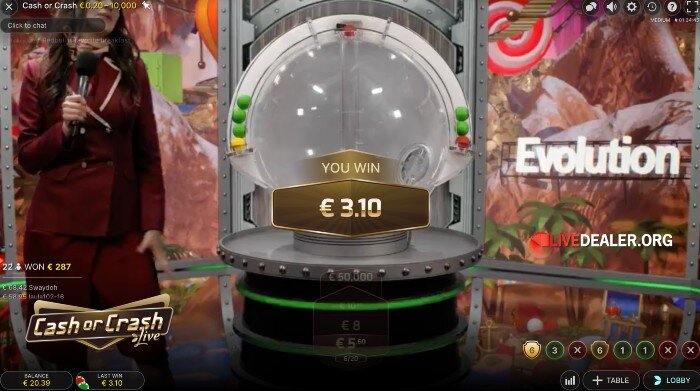
Cash or Crash Live carves out its own territory in the live game show world https://cashorcrashcasino.com. Its charm is found in a potent mix of studio spectacle and game design that makes each round a personal challenge of nerve. This is not a mere spin of a roulette wheel. In this experience, you are in the pilot’s seat, actively deciding that determine your winnings. The idea captivates you with an increasing multiplier, then challenges you to take it before a hidden “crash” wipes the slate clean. To get the most out of the game, you must ignore the glitz and grasp its real function. Let’s break down the phases, the presenter’s part, the mathematics of risk, and what players can realistically do to steer through the excitement.
Mathematical Foundations and Risk
Let’s look at the data that make the game tick. The crash point for every round comes from a set statistical distribution. Regular, low multipliers like 1.2x or 1.5x have a high chance of being selected. Sky-high multipliers are possible, but are exponentially more improbable. This system keeps the game balanced. The regular, small crashes pay for the rare, huge potential payouts. The “Return to Player” (RTP) is a expected percentage spanning millions of plays. In a single gaming session, the swings are extreme. You aren’t betting against the house in a standard manner. You’re making choices against a hidden, random number. Keep these key facts in mind:
- Isolated Stages: Every round’s crash point is an independent occurrence. A crash at 1.2x in stage one tells you nothing about stage two.
- No Forecasting Ability: The random number generator ensures no predictable sequences. Previous crashes or large wins do not affect future rounds.
- House Edge: The game is designed with an inherent house edge, which is shown in the publicly disclosed RTP from the provider.
Tactical Approaches and Player Psychology
No tactic can defeat the core randomness. But you can employ structured methods to control your funds and your mental state. The key trade-off is a exchange. Do you guarantee assured gains, or pursue explosive profits? Users often adopt techniques like the “Fixed Cash-Out.” In this case, you choose ahead of time to withdraw at a specific multiplier, say 2x, in every round. This aims for consistent, small wins. The contrary is the “Let It Ride” method, where you risk multiple stages for a opportunity for a huge reward, acknowledging that failures will happen. A more calculated tactic is the “Percentage Bankroll” method, where you adjust your stake based on your existing gains. The most important element, though, is in your mind. Can you resist the “greed factor” when the ratio climbs? Can you prevent frustration after an early crash? Your greatest asset is setting clear boundaries for yourself before the session even launches.
Frequent Errors to Steer Clear Of

Look out for a few classic mistakes. The most damaging is “chasing” a crash. This signifies rashly boosting your stake after a loss, which goes against the process’s stage-independent structure. Another mistake is believing in the “hot hand” misconception, assuming a run of high multipliers is probable to carry on. Letting the host’s banter or the moves of other players distract you from your own pre-set plan is common. Also, do not misunderstand the sections. The Amber and Red Zones are not tests to conquer. They are warnings that the risk has increased. Entering any stage without a defined objective turns the game from a session of decisions into a sheer emotional ride. That journey hardly ever concludes favorably.
The Primary Purpose and Core Mechanics
The objective of Cash or Crash Live is simple on the outside. You must choose when to exit a growing multiplier before a secret “crash point” concludes the game and takes your winnings for that level. Each game starts with players making bets. A rocket then starts its journey, and a multiplier begins climbing from 1x. The trip has multiple stages. Prior to launch, a unknown crash multiplier is determined for every stage, hidden from everyone. As the multiplier climbs, players individually opts to hit “Cash Out,” fixing that multiplier on their bet, or to stay on board. If the rocket triggers the unknown crash point prior to a player cashes out, they forfeit their bet for that round. The pattern of risk and reward repeats over several phases. Surviving players build their profits gradually.
Dissecting the Game Phases
Think of the game as a sequence of distinct sections, every one a new gamble. Staying alive doesn’t remove you from the game. You proceed to the subsequent stage with your collected winnings intact, then begin the gambling process anew on the following part of the rocket’s path. This setup is critical. It generates a story, with pressure that mounts as you go. The presenter fuels the drama, announcing how many players are still aboard the rocket as the multiplier achieves scary levels. First rounds often feature cautious plays. Subsequent phases, with their big-winning multipliers, tempt you to bet the gains you’ve previously won. This division is the essence of the game’s appeal. It forces a sequence of individual, stressful decisions instead of just one.
From Low to High Risk: The Risk Escalation
Pay attention to the colored trajectory the rocket travels. It’s a key part of the game’s visual lexicon. The first part is typically a “Green Zone,” a lower-risk phase where a crash is still on the table. Afterward, the rocket might reach an “Amber Zone,” a clear warning that risk is growing. The concluding section is the “Red Zone.” Here, multipliers look their best, but the probability of a crash is mathematically at its maximum. Such visual cues are not merely ornamentation. They give you a visual shorthand for the degree of risk at any given time. They turn an intangible probability become tangible. Knowing the game is purposely alerting you about growing volatility is a critical piece of strategic information.
The function of the on-air host and RNG
The presenter goes beyond talk. They set the game’s emotional pace. While they cannot influence the result, they skillfully build suspense. They announce the climbing multiplier and offer live updates on what percentage of the crowd is cashing out at each level. That social cue can affect your head. But remember, the host works separately from the game’s engine: the Random Number Generator (RNG). The crash point for each stage is established by a certified RNG the instant the stage begins. This ensures fairness and total unpredictability. The host has no clue when the crash will happen. Their job is entertainment. The RNG’s job is certifiable fairness. This combination merges transparent live action with provably random results.
Conclusion: A Harmony of Luck and Decision
Cash or Crash Live is a intriguing fusion of pure luck and intentional choice. Its mechanics are built to weave a tale of increasing stakes, powered by a transparent RNG and livened by a charming host. Determining victory as a entertaining and likely lucrative round depends on a few things. It’s less about predicting the uncertain and rather about grasping how the game is designed. It calls for controlling your money with restraint and curbing the emotional urges the game expertly triggers. By studying its levels, respecting its numeric basis, and following a personal plan, you can transform your experience. You transition from puzzled uncertainty to knowledgeable involvement in a remarkably thrilling live game show.